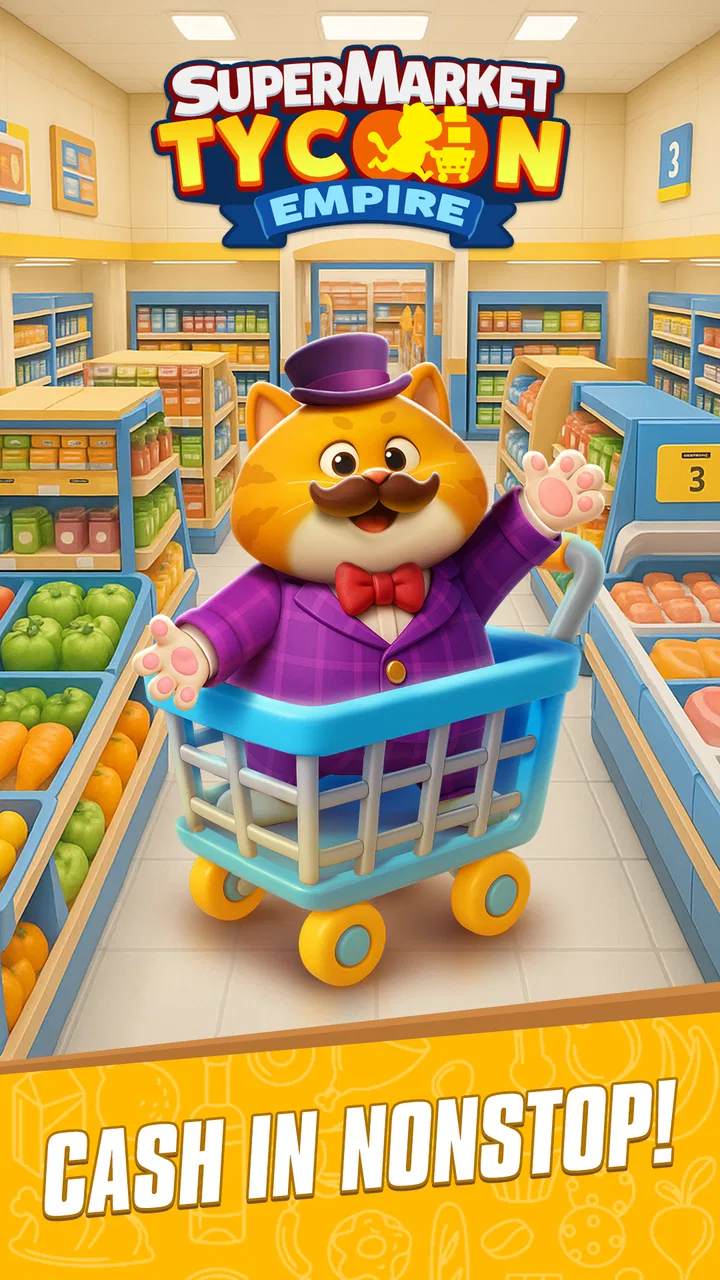
Supermarket Tycoon Empire
- 4.8
- Rating
- 100.00K
- Installs
- Free
- Price

 Analysis by App-foxy
I went into Supermarket Tycoon Empire expecting a familiar management game, but its appeal is more practical than flashy: it gives me a small retail business to organize, improve, and gradually turn into something that feels like my own. Developed by Sopot Studios, this free simulation game is aimed at players who enjoy making steady decisions rather than rushing through action stages.
The basic fantasy is easy to understand. I am building a supermarket, expanding its operation, and trying to make better choices as the business grows. That simple premise makes it approachable, especially when I only have a few minutes to play. At the same time, the supermarket setting gives the usual tycoon formula a more grounded rhythm than city-building or theme-park games. I am thinking about shelves, customer flow, upgrades, and the balance between spending now and improving future income.
It currently holds a 4.8 average from around 1.6 thousand ratings, which helps explain why it has attracted attention among mobile simulation players. The game is free to start, although optional purchases range from $0.99 to $299.99 per item. That wide purchase range is something I would keep in mind before handing the game to a younger player, even though its content rating is Teen.
You May Also Like

 Pandora - Music & Podcasts
Pandora’s Music Is Easy to Start, but Harder to Recover
Pandora’s strength is its low-effort path from a seed to a station. Its weak spot is how much confidence it asks you to place in connection, setup, and quiet recovery.

 8 Ball Pool
 Is Built on Rivalries, Rematches, and Routine
A close look at the rivalries, rematches, shared routines, and unanswered safety questions that turn a quick pool match into a persistent mobile community.

 Samsung Music
’s Quiet Strength Is Playing What You Already Own
Its reach comes less from spectacle than from dependable access to a personal library. That simplicity is both the app’s strongest retention engine and its ceiling.

 AccuWeather: Weather Radar
AccuWeather Review: A Quick, Clear Forecast for Everyday Decisions
For everyday plans, the best forecast is the one you can understand quickly. AccuWeather makes rain timing, radar, and local conditions easy to act on, with a few trade-offs.

 Hill Climb Racing
Why Hill Climb Racing Still Turns Crashes Into One More Run
A tiny car, a bumpy hill and one more upgrade: Hill Climb Racing keeps resurfacing because its simple chaos makes every near-miss feel personal.

 AliExpress - Shopping App
AliExpress Makes Global Shopping Feel Personal, but Shoppers Bear the Risk
AliExpress turns a global marketplace into a pocket-sized discovery engine. Its reach is useful, its shopping loop compelling, and its trade-offs easy to miss.
More From Our News Desk
View All News


How the supermarket management loop feels today
The strongest part of the experience is the repeatable management loop. I make a decision, watch the store respond, collect the result, and use that progress to make the next decision. This structure works well on a phone because it does not require me to remember a complicated story or master demanding controls. The supermarket itself becomes the main character, and each improvement gives the shop a clearer sense of progress.
What I like is that the setting naturally creates small priorities. A supermarket cannot simply be made bigger without considering whether the rest of the operation can support it. Even when the game presents its choices in a simplified way, I find myself asking whether I should improve the current store or save resources for a larger step. That decision is more interesting than blindly tapping every available upgrade.
For a realistic everyday session, I can imagine opening the game while waiting for a train, making a couple of management choices, checking the result of an earlier investment, and closing it without feeling that I abandoned a long match. Later, I can return and continue from the same business position. This makes it a better fit for short, repeated sessions than for someone looking for a deep evening-long strategy game.
The game also benefits from the supermarket theme because progress is easy to visualize. In a generic idle business game, numbers can become abstract very quickly. Here, the idea of a store becoming more capable gives each step a more understandable purpose. I am not merely increasing an invisible score; I am trying to make the business feel more successful.
Where the simulation is satisfying
The most satisfying moments come from linking an improvement to a practical result. If I spend resources, I want to understand why that choice matters. A good tycoon game makes me feel that I am managing a system, not just pressing a reward button. Supermarket Tycoon Empire works best when I pause before an upgrade and think about the next stage of the store rather than treating every purchase as automatically correct.
One useful habit is to avoid spending everything immediately. Keeping a reserve gives me room to react when the game presents a more important improvement. This is a small but meaningful trade-off: immediate progress feels good, but a carefully timed investment can make the next part of the session smoother. Players who approach the game this way will probably get more from its management side than players who simply collect and upgrade without planning.
Another practical approach is to use short sessions to review the supermarket rather than constantly chase progress. I like checking what has changed since my last visit and deciding on one clear objective. That could mean improving the current operation, preparing for expansion, or simply building enough resources to avoid being forced into a poor choice later. This gives the game a calmer pace and reduces the feeling that I need to tap through everything at once.
What the current version means for players
The current version is 1.0.63, while the game was released on September 5, 2025. I see that combination as a sign that the product is already in an active early stage rather than an old, forgotten release. The version number gives existing players a useful reference point when comparing their experience with the current build, especially if they installed it near launch.
For someone downloading it now, the practical benefit is that the game has had an opportunity to move beyond its first release state. I would still approach it as a developing mobile title rather than a finished management classic. A version number alone does not tell me how extensive each change was, so I would judge the game by how stable and enjoyable the present loop feels on my device.
Existing users should also expect their experience to be shaped by ongoing adjustments. In a management game, even a small change to progression can affect how quickly upgrades feel worthwhile. That is why I would avoid building my entire strategy around one exact sequence of purchases. A flexible plan is safer: improve the parts that clearly help the store, keep some resources available, and be prepared to change priorities after an update.
The game has passed 100 thousand installs, so it is not an obscure experiment with no player interest. That does not guarantee that it will suit everyone, but it does make the current version easier to place: there is a real audience trying the supermarket-building concept, and the game has enough visibility to be worth considering if this particular theme appeals to you.
Free entry, spending pressure, and patience
The free price is a genuine advantage. I can try the core experience without paying upfront, which is exactly what I want from a mobile simulation whose long-term rhythm I cannot judge in advance. The important question is not whether the game costs nothing to install, but whether I can enjoy the management decisions without feeling pushed toward purchases.
My advice is to play slowly at first. I would not buy anything during the opening session simply because early progress can make almost any tycoon game feel generous. Instead, I would wait until I understand what the game expects me to do repeatedly and whether the normal pace suits me. This is especially important because the available in-app purchase range reaches $299.99 per item, a level that makes careful spending boundaries sensible.
That does not automatically make the game a bad choice. Some players like optional shortcuts, while others prefer earning every improvement through play. The trade-off is personal, but it should be clear before starting. If I know I will become frustrated whenever progress slows, a free-to-play tycoon structure may tempt me to spend more than intended. If I am comfortable treating the game as a gradual routine, the free entry point is much more attractive.
I would also recommend disabling impulse buying habits before a long session. The best way to enjoy this type of game is to decide in advance whether I am playing for relaxation or trying to accelerate the business. Mixing those goals can make ordinary waiting feel like a problem that needs a purchase, even when the game is still perfectly playable as a slower simulation.
Small decisions that improve the experience
One non-obvious strength is that the game rewards a mindset closer to shop planning than to conventional gaming reflexes. I get more value from observing the relationship between an upgrade and the store’s next opportunity than from tapping as quickly as possible. That makes it useful for players who enjoy light optimization but do not want spreadsheets or complicated menus.
I also find that setting a stopping point helps. For example, I might decide to complete one improvement cycle and then leave, rather than continuing until every available action is exhausted. This prevents the loop from becoming repetitive and makes returning later feel purposeful. It is a simple technique, but it matters in a game built around recurring management actions.
A second useful insight is to separate “progress” from “expansion” in my thinking. Making the supermarket larger sounds like the obvious goal, but expansion only feels rewarding when the existing operation is healthy enough to support it. I therefore prefer to strengthen the current business before chasing the next visible milestone. Players who rush toward size may find the game less satisfying than those who build a stable foundation first.
A third trade-off concerns attention. This is not the right game if I want every decision to demand constant concentration. Its appeal comes from a relaxed business rhythm, and that also means some moments can feel slow for players who expect frequent surprises. I see that as part of the design’s identity, but it is worth recognizing before downloading it.
Who should play it, and who should skip it
I would recommend it to anyone who likes casual business simulation games, incremental progress, and the idea of turning a modest shop into a larger operation. It is particularly suitable for players who enjoy returning to the same project over several short sessions. The supermarket theme is friendlier and more concrete than many abstract tycoon settings, so it is easy to understand what the business is supposed to become.
It can also work for someone who wants a low-pressure game between more demanding titles. I do not need fast reactions, a complicated control scheme, or a large time commitment to appreciate the basic loop. The Teen rating is another reason parents should look at the game together with younger players, especially because optional purchases can be substantial.
I would skip it if I want a fully detailed retail simulator with deep staffing models, complex supply chains, or the freedom to redesign every part of a store. The experience is better understood as an accessible mobile tycoon game than as a professional supermarket management tool. I would also look elsewhere if I dislike idle-style pacing, repeated upgrade cycles, or any free game that includes optional spending.
Players who prefer direct competition may find the solo business-building focus less exciting than a multiplayer strategy game. Likewise, fans of narrative simulations should not expect the supermarket premise alone to provide a character-driven story. The game’s satisfaction comes from improving the operation, not from following a dramatic campaign.
How it compares with familiar alternatives
Compared with a city-building game, this title keeps the focus much narrower. I am not responsible for an entire population or a broad map; I am concentrating on one retail business. That makes the decisions easier to understand and gives each improvement a more immediate connection to the store. The trade-off is that there is less room for players who enjoy managing several industries at once.
Compared with a restaurant simulator, the supermarket setting feels less centered on individual orders and more centered on the health of a continuing business. I prefer that when I want a calmer pace and a broader sense of expansion. A restaurant game may be better for someone who wants constant customer-facing action, while this one suits someone who enjoys stepping back and planning.
Compared with a traditional premium tycoon game, the free entry point is convenient, but the design may feel less complete to players who expect every system to be available without optional purchases. Premium alternatives are often better for people who want a single upfront transaction and a more controlled progression structure. Here, patience and spending discipline are part of the experience.
That comparison is why I would not call it the best supermarket game for every player. Its strength is accessibility and a clear retail fantasy, not maximum simulation depth. If that boundary is acceptable, the focused design works in its favor. If I want a detailed economic model, I would choose a deeper management game even if it takes longer to learn.
What I would watch as the game develops
Because the game is still associated with an early version line, I would watch how Sopot Studios continues to shape the management loop. The most important question for me is whether future changes add meaningful decisions or merely increase the amount of tapping. New layers are valuable only when they make the supermarket more interesting to run rather than making progress feel busier.
I would also pay attention to how the balance between free play and optional purchases develops. A healthy version should let patient players understand and enjoy the business without making every satisfying improvement feel locked behind acceleration. The current purchase range means this is not a minor detail; it is central to deciding whether the game remains comfortable for a broad audience.
For existing players, updates may be most valuable when they improve clarity and reduce friction in the daily routine. I would welcome changes that make it easier to understand why a particular investment matters, especially when the store reaches a more demanding stage. Clearer feedback would help the simulation feel more strategic and less like a sequence of rewards.
New players should treat the current build as a chance to test the concept, not as a promise of unlimited depth. I would play without spending, learn the pace, and decide whether the supermarket’s gradual growth is enough to keep me interested. That approach gives the game a fair chance while protecting me from confusing impatience with a genuine need for an upgrade.
Overall, I find Supermarket Tycoon Empire most enjoyable when I treat it as a patient retail project. It is free to start, easy to understand, and specific enough to make incremental progress feel tangible. Its limitations are equally clear: the pace may be too gentle for some players, the simulation may not satisfy serious management fans, and the optional purchase range deserves caution.
My final recommendation is therefore selective but positive. If you want a casual supermarket-building game that fits into short sessions and gives you small business decisions to think about, I would try it. Start slowly, keep a spending limit, and focus on building a stable operation before chasing expansion. Its best quality is the feeling that each careful choice can make the store more capable; just make sure that relaxed, gradual progress is actually the kind of game you want.
FAQs for Supermarket Tycoon Empire
01What is Supermarket Tycoon Empire?
Supermarket Tycoon Empire is a supermarket management and simulation game in which you build, organize, and expand your own retail business. You typically begin with a small store and gradually unlock new departments, products, employees, upgrades, and facilities. The main objective is to attract customers, keep shelves stocked, improve service, and earn enough money to grow your supermarket into a larger commercial empire.
02How do you play Supermarket Tycoon Empire?
Gameplay focuses on completing everyday supermarket management tasks. You may need to purchase inventory, place products on shelves, manage checkout areas, hire or improve staff, and invest earnings in store upgrades. As the business grows, customer expectations and operational demands usually increase. Success depends on balancing spending and income while expanding at the right pace instead of using all available money on upgrades immediately.
03Is Supermarket Tycoon Empire free to download and play?
Supermarket Tycoon Empire can generally be downloaded without an upfront purchase, but the experience may include optional in-app purchases. These purchases can provide currency, boosts, upgrades, or other conveniences, while normal progress is usually possible through regular gameplay. Advertising may also be included, so users who prefer uninterrupted sessions should check the store listing and the game’s purchase settings before downloading.
04Can Supermarket Tycoon Empire be played offline?
Offline availability may depend on the specific version and feature being used. Basic management activities can sometimes remain accessible without a continuous internet connection, but advertisements, cloud saving, updates, events, leaderboards, and in-app purchases generally require online access. If uninterrupted offline play is important to you, it is best to test the game after installation and review its current Android or iOS store description.
05Is Supermarket Tycoon Empire suitable for children and casual players?
The game is generally approachable for casual players because its controls and objectives are based on familiar supermarket activities rather than complicated mechanics. However, parents should review the listed age rating, advertising, data practices, and optional purchases before allowing children to play. Progression systems and time-based rewards may also encourage repeated sessions, so parental controls can be useful for younger users.
Pros
- Simple controls make it easy for new players to start managing stores.
- Unlockable upgrades create a steady sense of progression.
- Short play sessions work well for playing on the go.
- Store expansion provides clear goals and rewarding milestones.
- Bright visuals and straightforward menus keep the game accessible.
Cons
- Progress can slow noticeably without frequent upgrades or spending.
- Repeated stocking and checkout tasks may feel monotonous over time.
- Ads can interrupt gameplay and reduce the pace of progression.
- Limited strategic depth may disappoint experienced management-sim players.
- Some features may require an internet connection to function properly.

Supermarket Tycoon Empire
Gallery